
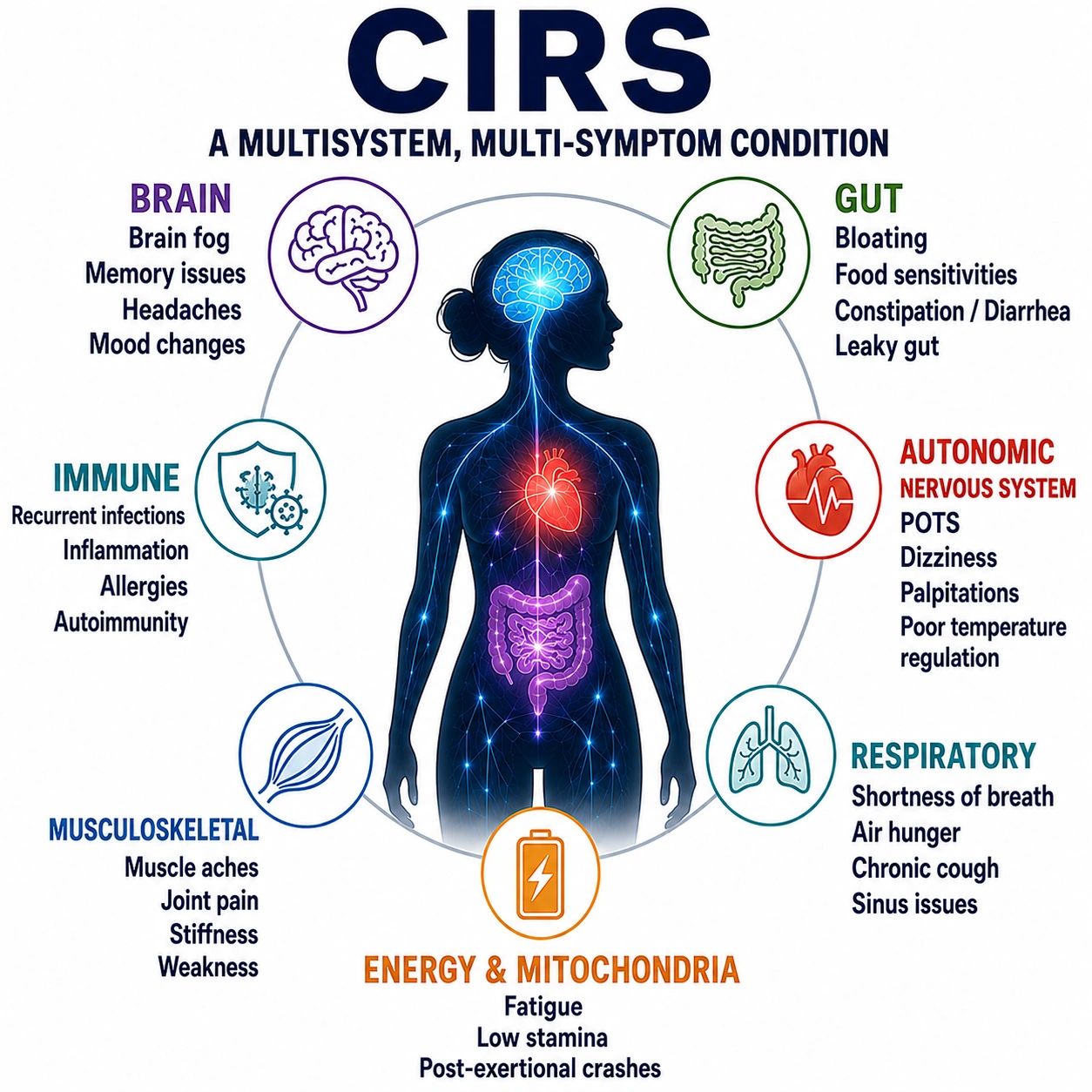
CIRS: Why Chronic Inflammation Becomes a Whole-Body Illness — and Why Treatment Must Be Done in the Right Order
One of the most frustrating things I hear from patients with Chronic Inflammatory Response Syndrome (CIRS) is:
“I have been doing everything. Why am I still sick?”
They have tried supplements. Detox programs. Hormones. IVs. Gut protocols. Peptides. Diets. Exercise programs. Sometimes they have seen multiple specialists because their symptoms seem completely unrelated.
Fatigue. Brain fog. Bloating. Food sensitivities. Headaches. Poor sleep. Exercise intolerance. Palpitations. POTS-like symptoms. Muscle aches. Hormone problems. Anxiety. Memory issues.
The problem is that CIRS is not a single-organ disease.
It is essentially a multisystem, multi-symptom inflammatory condition in which the immune system has difficulty shutting off an inflammatory response after certain environmental or biological triggers.
That is why treating one symptom at a time often gets us nowhere.
And it is also why the order of treatment matters.
What Causes CIRS?
CIRS stands for Chronic Inflammatory Response Syndrome.
The simplest way I explain it is this:
Something triggers the immune system — but instead of mounting an appropriate response and then calming down, the inflammatory response keeps going.
Potential triggers can include exposure to the complex mixture of organisms and compounds associated with water-damaged buildings and other biotoxin exposures. Infectious or immune-modulating illnesses may also contribute to or amplify inflammatory illness in susceptible individuals.
Examples may include:
- Water-damaged buildings and mold-related exposures
- Mycotoxins and other microbial products
- Actinomycetes and endotoxins
- Lyme and other tick-borne illnesses
- COVID-19 and post-infectious inflammatory states
- Epstein-Barr virus and other immune-modulating infections
The exact biology and triggers of CIRS remain an evolving area of medicine, but the central concept is immune dysregulation with persistent inflammation affecting multiple systems simultaneously.
Why Do Some People Get Sick While Others Don't?
This is an important question.
Two people can live or work in the same building. One develops severe symptoms while the other seems completely fine.
Part of that difference may involve genetic susceptibility, particularly certain HLA-DR/DQ variants associated with immune recognition and response.
In other words, the problem isn't simply:
“Were you exposed?”
The bigger question is:
“How did your immune system respond to that exposure?”
This helps explain why CIRS can look dramatically different from one person to another.
CIRS Creates a Vicious Cycle
Think of the immune system like a smoke alarm.
Normally:
Trigger → immune response → threat removed → alarm turns off.
In CIRS, the pattern can become:
Trigger → immune activation → inflammation → cellular dysfunction → more inflammatory signaling → continued immune dysregulation.
Eventually, inflammation itself becomes part of the problem.
And because inflammatory signaling affects virtually every organ system, the symptoms can appear unrelated.
The brain
Patients may experience:
- Brain fog
- Poor concentration
- Word-finding difficulty
- Memory problems
- Headaches
- Sleep disturbance
- Mood changes
The autonomic nervous system
Patients may develop:
- POTS-like symptoms
- Palpitations
- Dizziness
- Exercise intolerance
- Temperature dysregulation
- Abnormal sweating
The gut
We may see:
- Bloating
- Constipation or diarrhea
- Food sensitivities
- Altered microbiome
- Increased intestinal permeability
- Poor nutrient absorption
Energy and mitochondria
This is one of the most important pieces of the puzzle.
Mitochondria are essentially the energy-producing engines inside our cells.
When chronic inflammation, oxidative stress and immune dysregulation interfere with mitochondrial function, the body simply cannot generate energy efficiently.
The result may be:
Fatigue. Poor exercise tolerance. Slow recovery. Brain fog. Muscle weakness. Post-exertional crashes.
This is why I often tell patients that CIRS isn't simply about “getting mold out.”
We ultimately have to restore the terrain of the body.
Why We Use Visual Contrast Sensitivity — VCS — Testing
One of the simplest tools we can use during this process is Visual Contrast Sensitivity testing, or VCS.
VCS doesn't test whether you can read tiny letters like a routine eye exam.
Instead, it measures how well your visual and neurological systems can distinguish subtle differences between light and dark patterns.
Interestingly, contrast-sensitivity testing has a much longer history than CIRS. It has been studied in settings including U.S. Navy aviation and pilot visual performance.
Later, Dr. Ken Hudnell and Dr. Ritchie Shoemaker's work helped bring VCS into the evaluation of people with environmental and biotoxin-associated illness. Research in exposed populations found abnormalities in contrast sensitivity, and VCS subsequently became part of the evolving CIRS framework.
Why do I like VCS?
Because it gives us a simple, inexpensive, noninvasive functional marker that we can follow over time.
We can perform it before treatment and repeat it as the patient progresses.
However, this distinction is important:
VCS is a screening and monitoring tool — it is not, by itself, a diagnosis of CIRS.
Other conditions and neurotoxic exposures can also affect contrast sensitivity. Diagnosis requires looking at the patient's symptoms, exposure history, examination and appropriate biomarkers together.
Treating CIRS Is Like Climbing a Staircase
This is where CIRS treatment is very different from many conventional treatment approaches.
You cannot simply throw everything at the patient at once.
I frequently see patients arrive taking 20 supplements, undergoing multiple detox therapies, changing hormones, trying peptides and attempting to kill every possible organism simultaneously.
That can actually make an already overwhelmed system even more overwhelmed.
Instead, treatment needs to be deliberate, sequential and individualized.
The Shoemaker approach itself is structured as a sequence in which earlier abnormalities are addressed before moving to later restorative therapies.
I prefer to explain the overall journey in phases.
STEP 1: Stop the Exposure
You cannot empty a bathtub while the faucet is still running.
Before aggressively trying to detox someone, we have to determine whether the patient continues to encounter the trigger.
That may mean evaluating:
- Home
- Workplace
- Previous water damage
- HVAC systems
- Hidden moisture
- Other environmental sources
This is often one of the hardest parts of treatment — but also one of the most important.
Continued exposure can undermine everything we do afterward.
STEP 2: Prepare the Body to Eliminate
This is a step that is frequently overlooked.
Before aggressively mobilizing toxins, we need to make sure the body can actually move them out.
Think about the pathway:
Mobilize → Process → Bile → Gut → Bind → Bowel Movement → OUT
If we aggressively mobilize compounds but the patient is constipated, bile flow is poor, antioxidant capacity is depleted or the gut isn't functioning properly, we may simply make the patient feel worse.
This is why early support may include, when appropriate:
- NAC and glutathione support
- Antioxidant support
- Phosphatidylcholine
- Essential fatty acids
- Bile and liver support
- Adequate fiber
- Gut and microbiome support
- Regular bowel movements
- Hydration
- Renal support
- Lymphatic support
The goal isn't to “detox harder.”
The goal is to make detoxification and elimination more efficient.
STEP 3: Bind and Remove the Biotoxin Burden
Once the body is prepared, we can focus more deliberately on reducing the ongoing biotoxin burden.
Prescription bile-acid sequestrants such as cholestyramine or colesevelam (Welchol) are used in the Shoemaker approach. These medications remain within the gastrointestinal tract and bind bile acids, interrupting enterohepatic recirculation so bound material can leave through the stool.
This is different from simply taking random “detox binders.”
Other substances such as charcoal, fibers or chlorella may have roles in broader integrative protocols, but they are not interchangeable with prescription bile-acid sequestrants, and the evidence supporting different binders varies considerably.
Again, this is why bowel function matters so much.
Binding something is only useful if you can eliminate it.
STEP 4: Calm the Runaway Inflammatory Response
Removing the trigger is only half the battle.
Remember — by this point, the immune system may have been dysregulated for months or years.
So now we work on calming the inflammatory environment.
Depending upon the individual patient's findings, this may involve addressing inflammatory pathways, oxidative stress, gut dysfunction, membrane health, nutritional deficiencies and other abnormalities identified during testing.
This is also where laboratory markers become useful.
Rather than asking only:
“Do you feel better?”
we want objective evidence that the inflammatory physiology is moving in the right direction.
STEP 5: Repair the Gut
I cannot emphasize this enough:
The gut is not separate from the immune system.
The intestinal barrier, microbiome, bile acids, immune signaling and toxin elimination pathways constantly communicate with one another.
Chronic inflammation may contribute to:
- Dysbiosis
- Food sensitivities
- Poor nutrient absorption
- Altered intestinal permeability
- Irregular bowel movements
And an unhealthy gut can then feed inflammatory signaling back into the system.
This is why gut repair isn't simply about taking a probiotic.
We may need to work on the microbiome, intestinal barrier, motility, fiber, nutrition and elimination simultaneously.
STEP 6: Rebuild the Mitochondria and Cell Membranes
Once the inflammatory burden starts coming down, we can focus more aggressively on repair.
Cell membranes are built largely from lipids.
Phosphatidylcholine and essential fatty acids therefore become particularly interesting from a membrane-support perspective.
At the same time, mitochondrial support becomes increasingly important because mitochondria are responsible for producing the energy required for virtually every healing process in the body.
If the mitochondria cannot generate energy efficiently, the body has a much harder time repairing tissue, regulating the nervous system, maintaining cognition and recovering from exertion.
This is why mitochondrial restoration is not an optional afterthought.
It is part of rebuilding the body after chronic inflammation.
Where Supportive Therapies Fit In
I am a strong believer in supportive therapies — when they are used in the correct place.
These therapies should not replace the core treatment pathway.
They should support it.
Depending upon the individual patient, adjunctive therapies may include:
Lymphatic drainage
Lymphatic circulation is one of the body's major fluid and waste-transport systems.
Supporting lymphatic movement can be especially useful while we are working on elimination and recovery.
IV therapy
Selected IV protocols may provide nutritional, antioxidant or metabolic support.
Examples used in individualized programs may include:
- Glutathione
- Phosphatidylcholine
- Nutrient infusions
- NAD-related metabolic support
But an IV cannot compensate for continued exposure.
Hyperbaric Oxygen Therapy — HBOT
HBOT may be considered as an adjunct for selected patients to support oxygen delivery and recovery.
But again:
HBOT is supportive care — it is not a substitute for identifying the trigger, removing exposure and correcting the inflammatory physiology.
Nervous-system support
Chronic illness is stressful to the autonomic nervous system.
Some patients benefit from therapies aimed at helping shift the body away from persistent sympathetic “fight-or-flight” activation.
This may include approaches such as BrainTap, breathing work, meditation, DNRS or neural therapy other nervous-system retraining strategies.
Why We Don't Start With Hormones, Heavy Metals or Aggressive Detox
This is another mistake I see frequently.
A patient with unresolved CIRS may also have:
- Hormone abnormalities
- Heavy metals
- Gut dysbiosis
- Nutrient deficiencies
- Thyroid abnormalities
- Mitochondrial dysfunction
Of course these deserve attention.
But timing matters.
If the body is still dealing with significant biotoxin exposure and uncontrolled inflammation, aggressively pushing detoxification or attempting to optimize every hormone simultaneously may not produce the response we expect.
My philosophy is:
First reduce the inflammatory burden and restore the body's ability to regulate itself. Then address the deeper layers.
The Final Phase: VIP
VIP stands for vasoactive intestinal polypeptide.
Despite its name, VIP isn't simply a “gut peptide.”
It is a regulatory neuropeptide with effects involving immune signaling, vascular regulation, the nervous system and multiple other physiological systems.
In the Shoemaker Protocol, intranasal VIP sits at the top of the treatment pyramid — not at the bottom. It is considered only after the earlier treatment steps have been completed and specific criteria are met.
That distinction is extremely important.
Before VIP, the Shoemaker framework calls for evidence that exposure has been adequately addressed and other prerequisites are satisfied, including appropriate VCS and environmental/MARCoNS criteria.
Published open-label work in previously treated CIRS patients has reported improvements in symptoms and inflammatory biomarkers during VIP therapy, and subsequent research has explored changes in neuroimaging and gene-expression patterns. These studies are promising, but the evidence base remains much smaller than that available for therapies used in many mainstream chronic diseases.
I like to think of VIP as:
RESET → REGULATE → RESTORE
rather than:
DETOX.
By the time we reach VIP, the goal has shifted from simply getting something out of the body to helping restore more normal immune and neuroregulatory physiology.
How Long Does CIRS Treatment Take?
This is not a 30-day detox.
For many of the patients we treat, a realistic journey may be approximately 9–16 months, although it can be shorter or considerably longer depending upon exposure, severity, genetics, comorbidities, response to treatment and whether re-exposure occurs.
And progress is rarely perfectly linear.
There may be:
Improvement → plateau → adjustment → improvement again.
That doesn't necessarily mean treatment isn't working.
It means we are treating a complex biological system.
Why Every Step Matters
This may be the single most important lesson I can give someone beginning a CIRS journey:
Do not skip the foundation because you are anxious to get to the finish line.
You cannot VIP your way out of an active exposure.
You cannot supplement your way out of a contaminated environment.
You cannot bind effectively if you cannot eliminate.
You cannot rebuild mitochondria while continuously overwhelming the system.
And you cannot expect hormone optimization alone to correct a body that remains trapped in an uncontrolled inflammatory state.
The process is sequential for a reason.
REMOVE THE TRIGGER
↓
OPEN AND SUPPORT ELIMINATION
↓
BIND AND REDUCE THE BIOTOXIN BURDEN
↓
CALM INFLAMMATION
↓
REPAIR THE GUT
↓
RESTORE CELL MEMBRANES + MITOCHONDRIA
↓
RETRAIN AND SUPPORT THE NERVOUS SYSTEM
↓
CORRECT REMAINING PHYSIOLOGICAL ABNORMALITIES
↓
VIP — RESET, REGULATE & RESTORE
That is how I want patients to understand CIRS.
It isn't simply “mold toxicity.”
It is a whole-body inflammatory illness that requires a whole-body recovery strategy.
And while supportive therapies, supplements and advanced treatments can be extremely useful, the sequence matters just as much as the treatment itself.
The goal isn't simply to lower a lab value.
The goal is to help the immune system regulate again, restore cellular energy, rebuild resilience and ultimately help the patient get their life back.
Frequently Asked Questions About CIRS
Frequently Asked Questions About CIRS
What is CIRS?
CIRS (Chronic Inflammatory Response Syndrome) is a multisystem condition associated with a persistent, dysregulated inflammatory response following certain environmental or biological triggers. It can affect the brain, gut, immune system, autonomic nervous system, hormones and cellular energy production.
What can trigger CIRS?
CIRS is most commonly discussed in connection with water-damaged buildings and biotoxin exposure. Other infectious or immune-modulating illnesses, including Lyme disease and post-viral inflammatory states, may contribute to or worsen inflammatory symptoms in susceptible individuals.
What are common symptoms of CIRS?
Symptoms vary considerably but may include brain fog, fatigue, memory problems, headaches, poor sleep, gut problems, food sensitivities, muscle and joint pain, dizziness, palpitations, exercise intolerance and POTS-like symptoms. A major clue is often the presence of symptoms involving several body systems at once.
Why do some people develop CIRS while others don't?
Individual susceptibility appears to matter. Certain HLA genetic variants have been proposed as one factor that may influence how the immune system responds to biotoxin exposure. HLA testing alone, however, does not diagnose CIRS.
What is VCS testing for CIRS?
Visual Contrast Sensitivity (VCS) testing measures the ability to distinguish subtle differences in visual contrast. It is a quick, noninvasive tool used in some CIRS protocols for screening and monitoring progress. VCS is not a stand-alone diagnostic test for CIRS.
How is CIRS treated?
CIRS treatment is typically step-wise rather than everything at once. The process may include identifying and removing ongoing exposure, supporting elimination, reducing biotoxin burden, addressing inflammation and gut health, rebuilding mitochondrial and cellular function, supporting nervous-system regulation and correcting remaining abnormalities.
The order matters.
How does NY360 use supportive therapies during CIRS treatment?
Depending on the patient and stage of recovery, NY360 Wellness Medicine may incorporate supportive therapies such as lymphatic drainage, HBOT, IV therapy, red light therapy, mitochondrial support and nervous-system regulation.
These therapies are designed to complement the core treatment plan—not replace exposure removal or other foundational steps.
How long does CIRS treatment take?
Every patient is different, but at NY360 Wellness Medicine, the CIRS recovery process may take approximately 9–16 months for many patients. More complex cases may require longer, particularly when there has been prolonged exposure or re-exposure.
What is VIP and when is it used?
VIP (vasoactive intestinal polypeptide) is a regulatory neuropeptide used as a later step in some CIRS treatment protocols. It is generally considered after foundational treatment steps have been completed and appropriate criteria are met, rather than at the beginning of treatment.
How does NY360 Wellness Medicine approach CIRS?
At NY360 Wellness Medicine, we look beyond individual symptoms to understand the bigger inflammatory picture. Our approach combines root-cause evaluation, appropriate testing, physician-guided treatment and supportive therapies in a personalized, step-wise plan.
CIRS recovery isn't about doing everything at once. It's about doing the right things in the right order.
Medical Disclaimer: CIRS is an evolving area of medicine, and its symptoms overlap with many other conditions. Testing and treatment should be individualized and performed under appropriate medical supervision.
Take the first step towards wellness....
Call us: 516-363-3622
Email us: connect@ny360wellness.com
Or contact us here
True Wellness comes from within,
Dr. Adeeti Gupta